STI symptoms in men

Medically reviewed by
Dr Brenda IkejiLast reviewed: 28 Apr 2025
Sexually transmitted infections (STIs) are very common. Almost half a million people in England get a new STI diagnosis every year. Overall, men are more likely to get diagnosed with STIs than women. However, symptoms are different for men and women, so it is important to look out for symptoms which may apply to you.
You might not always get symptoms if you have an STI, which can mean that you may unintentionally pass an STI on to others. So, if you’ve ever had unprotected sexual contact it’s important to get tested, even if you have no symptoms.
STI tests can help you quickly and easily get tested and get a diagnosis. This can put your mind at rest, and also help with treating any infections or any STI symptoms you’re experiencing.
In this guide, you’ll learn about STI symptoms in men, how long it takes to get symptoms, and how to manage them.
What is a sexually transmitted infection?
Sexually transmitted infections (STIs) are infections or conditions that are often spread through sexual contact. STIs can be caused by bacteria, viruses, or parasites. They can be spread through vaginal, anal, or oral sex. Some of them can also be spread through touch, saliva, and sharing sex toys.
Although forms of treatment exist for every type of STI, they can sometimes have serious health consequences if they are left untreated, so be sure to look out for symptoms and get tested regularly to avoid long-term complications.

from £135.99

from £30.99

from £35.99

from £35.99

No results found.
Please check your spelling or try another treatment name.
Common STI symptoms in men
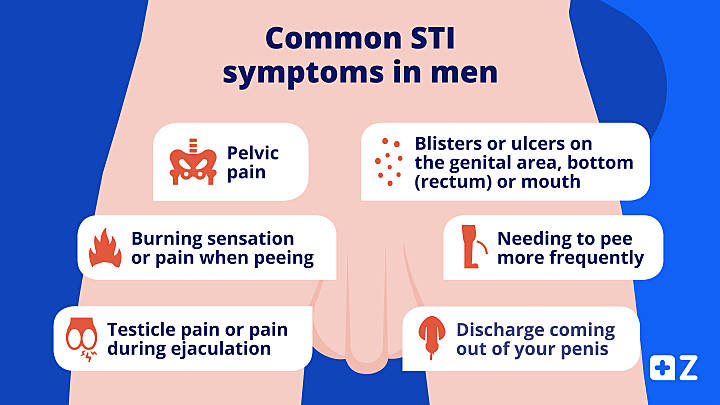
Some common general STI symptoms in men include:
- needing to pee more frequently
- burning sensation or pain when peeing
- pelvic pain
- ulcers or blisters on your genital area, bottom (rectum) or mouth
- discharge coming out of your penis
- testicle pain or pain during ejaculation
- flu-like symptoms, such as fatigue or muscle aches
- inflammation in the urethra (the tube where urine and sperm pass through)
If you have an STI, you might have some of these symptoms. However, you may not be experiencing symptoms at all. Even if you have no symptoms, it’s still a good idea to get an STI test after having unprotected sex.
You can get STI testing kits from ZAVA or at your nearest sexual health clinic.
It’s important to be aware that some men’s STI symptoms aren’t obvious – you could have no symptoms or only non-specific symptoms (such as aching muscles). Even if you’re not symptomatic, you can still potentially pass the infection on to sexual partners.
Symptoms may not appear for months or even years after infection. Symptoms can also seem to go away by themselves, but this doesn’t mean the infection has completely disappeared.
— Dr Brenda Ikeji, Medical Editor.It can be distressing to experience STI symptoms. Unfortunately, there’s still a lot of stigma around getting a diagnosis, despite how common they are. You should remember that there’s nothing to be embarrassed about, doctors and healthcare workers see this day to day. What’s important is your health and getting the right treatment for you.
Symptoms of common STIs for men
Symptoms of STIs in men can vary from one condition to the next. We’ve listed some male STI symptoms for a number of common infections.
Chlamydia symptoms in men
Common symptoms of chlamydia in men include:
- white, cloudy or watery discharge from the tip of the penis
- pain, discomfort or a 'burning sensation' when urinating
- inflammation, tenderness and pain in and around the testicles
- rectal pain, discharge and bleeding
- conjunctivitis (eyes)
- throat infection
These are likely to appear within 1 to 3 weeks of initial exposure.
Gonorrhoea symptoms in men
Common symptoms of gonorrhoea in men include:
- green or yellow discharge from the penis
- pain when peeing
- soreness, swelling, itchiness, or redness of the penis
- itchiness or tenderness in the rectum
Symptoms of gonorrhoea usually develop between 2 and 5 days after infection, but can develop as late as 14 days after infection or even longer.
Genital herpes symptoms in men
Common symptoms of genital herpes in men include:
- pain, tingling, or burning on or around your penis
- small blisters on your penis and the surrounding area
- red open sores on your penis, caused by blisters that have burst
- difficulty peeing or pain when peeing
You may get some or all of these symptoms, which can appear weeks or sometimes years after being infected with herpes.
HIV symptoms in men
After you've been infected with HIV, you may feel like you’ve got the flu for around a week. For example, you may:
- have a fever
- feel extremely tired (fatigued)
- have swollen lymph nodes
- have a rash
- have a sore throat
Even when you get better, the HIV virus will stay in your body. The virus can then damage parts of your immune system without you realising it. A weakened immune system caused by HIV is called acquired immunodeficiency syndrome (AIDS). It can take years between being infected with HIV and getting AIDS.
Trichomoniasis (‘trich’) symptoms in men
Trichomoniasis is an STI caused by a parasite. Symptoms of trichomoniasis in men include:
- pain when urinating or during ejaculation
- urinating a lot more than usual
- thin, white discharge
- soreness, swelling, and redness around the head of the penis or foreskin
How quickly do STI symptoms show in men?
Symptoms of STIs in males often start within 1 to 3 weeks after having unprotected sex. People experience symptoms earlier or later than this depending on the STI.
Some viruses or bacteria that cause STIs can stay inside your body for a long time and hide from your immune system. A trigger, such as stress, can cause the virus or bacteria to activate, which is when you’ll start seeing symptoms.
If you start to feel unwell weeks or months after having unprotected sex, get tested to check for any STIs. We recommend getting tested even if you have no symptoms, or when you get a new sexual partner.
How does a man know if he has an STI?
The only way to know if you have an STI is by doing an STI test. This is because many STIs share symptoms with other conditions that are not sexually transmitted.
For example, male thrush (which isn’t an STI) can cause pain during urination, which is also a symptom you can get with many STIs. Another reason that doing STI tests is important is because many men with STIs don’t have any symptoms.
Remember, you cannot tell if someone has an STI just by looking.
What happens if an STI is left untreated?
If you leave an STI untreated, you’ll be at risk of getting further health problems. As you won’t always get symptoms when you have an STI, it might be difficult to know if you’ve been exposed. An untreated STI can spread to other sexual partners if you have unprotected sex in the future.
Leaving an STI untreated can also cause infertility, as the quality of your sperm can be affected. For example, gonorrhoea can cause inflammation around your testicles which will affect sperm production. Infertility can happen with several STIs, such as chlamydia and syphilis.
If your partner is a pregnant woman and you pass an STI on to her, this can affect the baby or cause a miscarriage.
Some men can get vaccinated against certain STIs, such as the human papillomavirus (HPV) which causes genital warts. HPV can lead to penile cancer in men and cervical cancer in women. To avoid this risk, you may want to consider getting a hepatitis B vaccine to protect your liver.
STI Treatments for men
STIs are easy to treat and treatment is readily available from sexual health clinics. You can also get treatment for STIs online from ZAVA, including for chlamydia and trichomoniasis.
Some STIs can be fully cured, often with antibiotics, if you get it treated early, and you can avoid any long term health consequences – this is why it is important to get tested.
STIs like HIV and genital herpes cannot be cured, however they can still be managed effectively with medication. This means most people can continue living their lives without any serious complications.
We recommend following safe sex practices to protect the health of yourself and others and avoid the complications of STIs.
How to reduce your risk of catching an STI
You can avoid STIs by practicing safe sex. Using condoms both or either on yourself or on a male partner’s penis is a highly effective way of protecting yourself and others from STIs. Clinical studies have found that condoms offer more than 90% protection against HIV, Hepatitis B, and gonorrhoea. Condoms are also effective for preventing the spread of syphilis (50 to 71%) and chlamydia (50 to 90%).
There are some kinds of STI, particularly genital herpes, that can be spread by skin contact, so wearing a condom won’t necessarily prevent the spread. If you have genital herpes, you can still have sex, but you should always wear a condom and abstain from sex during outbreaks, as this is when it’s easiest to give it to others. You should also avoid sharing sex toys.
Viral infections, such as the herpes simplex virus, which causes genital herpes, can stay dormant in your body. You can still pass genital herpes through skin-to-kin contact, even during the dormant periods, although this is less likely. If your partner has an STI, you should wait until they've received treatment before having sex. We recommend informing sexual partners that you have herpes so they can get tested and treated, as this can also prevent the spread of herpes.
If you often have sex with new partners, it’s important to get tested regularly.
How to get tested for STI symptoms
It’s important to get tested for STIs, whether you have symptoms or not. You may want to get an STI test if:
- you’ve recently had unprotected sex
- you have a new sexual partner
- you often have sex with different people, even if you practice safe sex, since some STIs can still be spread when using a condom
At ZAVA, we can deliver STI test kits quickly and discreetly to your door or to your nearest post office. You can then send the test back to our labs, and receive your results within 72 hours of your sample reaching them. At ZAVA we value confidentiality and security, so your results will not be emailed or texted to you, and you will receive an update in your patient account instead.
from £135.99
from £30.99
from £35.99
from £35.99
No results found.
Please check your spelling or try another treatment name.

Brenda studied medicine at St Georges University of London and has most recently worked in John Radcliffe Oxford University Hospitals, covering acute and general medicine.
Meet our doctorsLast reviewed: 28 Apr 2025
-
Sexually transmitted infections (NHS) [June 2021] [accessed March 2025]
-
How soon do STI symptoms appear? (NHS) [Nov 2019] [March 2025]
-
Sexually transmitted diseases (STDs) [Sept 2021] [accessed March 2025]
-
HIV and AIDS (NHS) [April 2021] [accessed March 2025]
-
7 STIs that affect male fertility [July 2020] [accessed March 2025]







 Secure payment


