
BMI calculator
Our basal metabolic rate (BMR) calculator can help estimate how many calories your body burns at rest.
Enter your age, sex, height, weight, and activity level to see your BMR – and get an estimate of your daily calorie needs based on your lifestyle.

Medically reviewed by
Dr Kathryn BasfordLast reviewed: 03 Feb 2026
Please remember: Results here only give a general guideline about your daily energy needs and do not replace medical advice. If you have any questions or concerns about your BMR result, speak to a GP or an online doctor.
Your BMR is the number of calories your body uses at rest, including for things like breathing, circulation, temperature control, and cell repair.
BMR is influenced by age, sex, height, weight, and body composition. It is different from body mass index (BMI), which only uses height and weight measurements to estimate whether you’re at a healthy weight. Your BMR might give a more detailed picture of your needs than your BMI.
Understanding your BMR is useful when planning weight changes. It gives you a baseline before daily activity is added.
To estimate total daily calorie needs, BMR is multiplied by your activity level to calculate your Total Daily Energy Expenditure (TDEE).
Your BMR is the number of calories your body burns at rest, while your TDEE is the total calories you burn in a day. Use our TDEE Calculator.
TDEE includes your BMR, movement, exercise, and digestion. When setting calorie targets for weight loss or maintenance, TDEE is the number to use. This can help you understand how many calories you need based on your lifestyle rather than resting needs alone.
If you’re using a BMR calculator to lose weight, it helps to understand how BMR fits into your total calorie needs.
Your BMR tells you the minimum calories your body needs each day. For weight loss, you then need to multiply your BMR by activity level to get your Total Daily Energy Expenditure (TDEE). Our BMR calculator does this for you automatically by providing an overview of calorie needs by activity level.
Once you know your calorie needs based on your TDEE, you can work out a calorie deficit. A deficit of 600 kcal per day is recommended for safe, steady weight loss – resulting in averages of around 1,900 kcal a day for men and 1,400 kcal a day for women.
This is just a guideline however, and your own calorie deficit is unique to you. Find out more about dieting safely in our guide to how many calories to eat for weight loss.
Our BMR calculator estimates your Basal Metabolic Rate (BMR) using the Mifflin–St Jeor equation. We chose this method because studies have found it provides a practical method of estimating BMR without you needing to visit a lab for personal testing.
To get your BMR result, you’ll need to enter this information into the calculator:
Our BMR calculator also asks for an activity level:
Your activity level does not change your BMR, but it allows the calculator to give you a second result, which is a simple estimate of how many calories you may burn in a day based on your lifestyle – this is called your Total Daily Energy Expenditure (TDEE).
You can learn more about Total Daily Energy Expenditure on our TDEE calculator page.
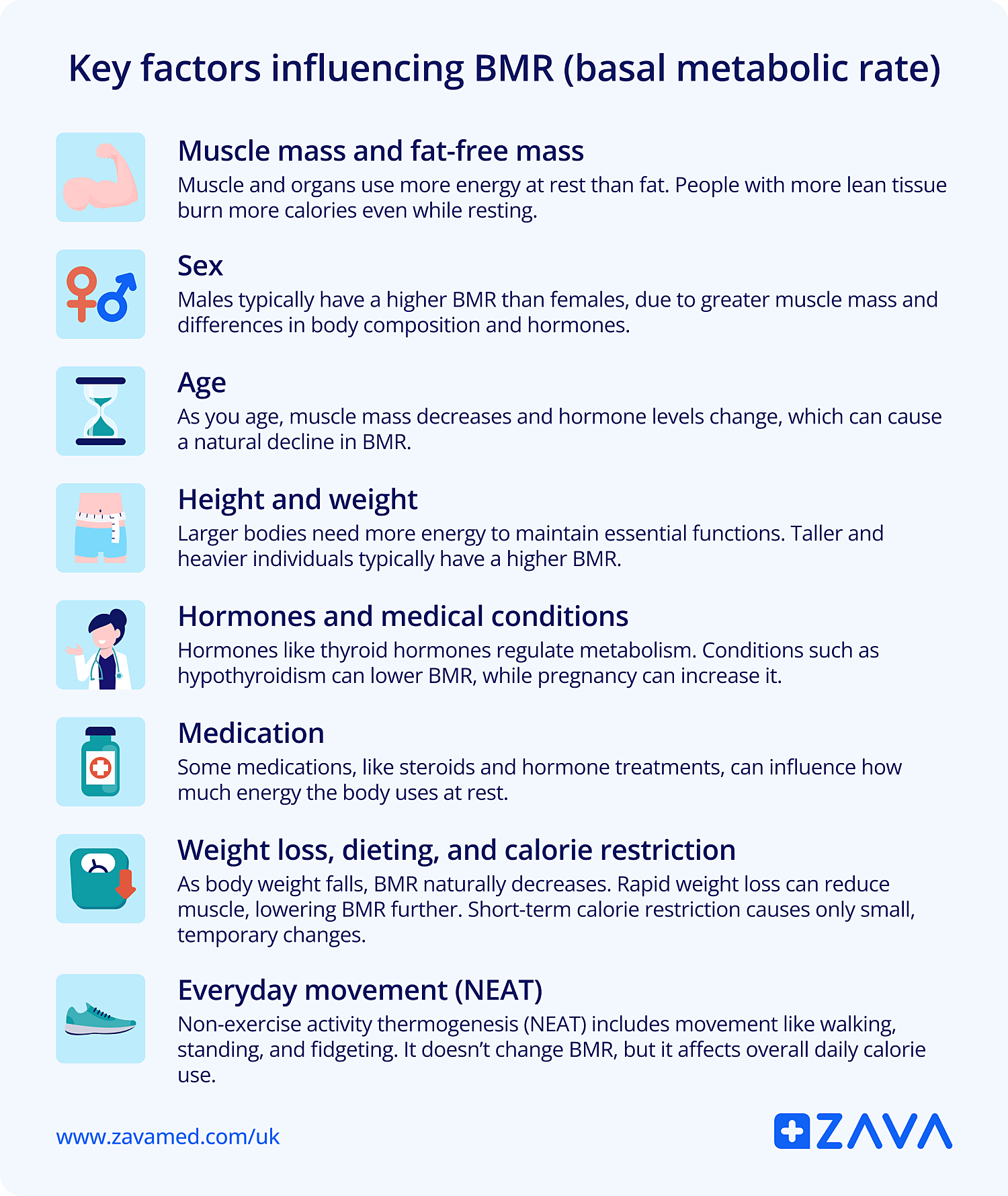
There are a few different biological, physiological, and lifestyle factors that can influence your BMR.
Muscle mass and lean tissue (muscle and organs) have the biggest effect on BMR because these tissues use more energy, even at rest.
People with more lean tissue naturally burn more calories at rest. This is true even when two people weigh the same. Building or maintaining muscle through strength training can help support a higher BMR, especially during weight loss.
Men generally have a higher BMR than women because they tend to have more muscle mass and a larger body size. A 2023 study of 50 adults found average BMR values of:
Hormone differences (such as testosterone and oestrogen) also contribute to this gap.
BMR usually decreases with age because muscle mass naturally reduces over time. Hormonal changes also play a role, including gradual reductions in growth hormone, testosterone, and oestrogen.
Staying active and including resistance exercises can help slow the decline in muscle mass as you age and support a healthier metabolic rate.
Taller and heavier people have higher BMRs because larger bodies usually need more energy to maintain essential functions.
Both muscle and fat contribute to this, although muscle requires more energy than fat. This is why two people of the same height but different body weights can have noticeably different BMRs.
Your hormones can also have an influence on metabolism. Some conditions can raise or lower your BMR, including:
Pregnancy can also increase your metabolic rate due to the energy needs of the developing foetus.
Some medicines, such as steroids and hormone treatments, can also affect metabolism.
BMR naturally goes down as you lose weight. Research shows that BMR decreases with each percentage of body weight lost, largely because the body needs less energy at a lower body weight.
Losing weight too quickly can reduce muscle, lowering BMR further. Eating enough protein and exercising can help maintain muscle during weight loss.
Weight loss medication, such as GLP-1 treatments, help reduce calorie intake by increasing fullness. They do not directly change your BMR, but as you lose weight while using them, your BMR may gradually fall in the same way it does with any weight loss.
Short periods of calorie restriction only cause a small, temporary drop in BMR.
A 2023 study found that eating 50% fewer calories than your usual needs for one week only reduced BMR by around 56 kcal/day in men and 66 kcal/day in women. BMR returned to normal once regular eating resumed.
This shows that short term dieting does not put the body into immediate ‘starvation mode’.
Non-exercise activity thermogenesis (NEAT) is the energy you burn from everyday movement, including standing, walking, fidgeting, or doing chores. It can vary by as much as 2,000 kcal/day between people of similar size.
NEAT does not change your BMR, but it can significantly affect your total daily calorie needs.
You should recalculate your BMR whenever your body weight or routine changes. This includes when:
“Many people continue using old calorie targets as their body changes. Updating your BMR helps you avoid eating too little or too much and can be especially helpful if you have reached a plateau or experienced unexpected weight changes.”

You can calculate your BMR using a formula that includes your age, weight, height, and sex.
The Mifflin–St Jeor equation is one of the most accurate for adults, which is why it’s used in our calculator. Your activity level is added afterward to estimate your TDEE (your total daily calorie needs).
There is no single ‘good’ BMR for weight loss because everyone’s metabolism is different.
Many healthy adults fall between 1,300 to 1,600 kcal a day, but weight loss depends on your TDEE and how many calories you eat compared with your daily needs. A higher or lower BMR does not mean you will lose weight more easily. What matters is creating a safe, steady calorie deficit based on your total daily energy use.
BMR varies between individuals because it is influenced by muscle mass, age, sex, weight, hormones, and overall health.
People with more muscle usually have a higher BMR, while those with less muscle may have a lower BMR. Medical conditions such as thyroid disorders can also affect BMR. Different calculators use different formulas too, but Mifflin–St Jeor is the most accurate for adults, which is why we use it in our calculator.
Different calculators use different equations, which is why results do not always match.
Common formulas include Harris–Benedict, Mifflin–St Jeor, and BIA (bioelectrical impedance).
The Harris–Benedict formula estimates BMR using age, sex, height, and weight, and was one of the earliest formulas developed for this purpose. Mifflin–St Jeor uses the same inputs but was developed later using more recent population data. Bioelectrical impedance analysis (BIA) estimates BMR based on body composition by measuring how electrical signals travel through the body, which can be influenced by factors such as hydration and testing conditions.
Research shows Mifflin–St Jeor is closest to clinical testing that measures energy use, the gold-standard method for measuring BMR, so it provides the most reliable estimate. For this reason, ZAVA uses the Mifflin–St Jeor equation.
A BMR of 1,500 kcal/day is normal for adults and does not indicate anything good or bad by itself.
Most adults fall around this number. Whether weight loss happens depends on your TDEE and how many calories you consume, not the BMR value alone. A safe calorie deficit should be planned using your full daily energy needs.
Dr Kathryn Basford is a GP based in London. She graduated from the University of Manchester and completed her GP training through Whipps Cross Hospital in London. Outside of work she enjoys baking and keeping active, running marathons, swimming, and triathlons.
Last reviewed: 03 Feb 2026
Metabolic Consequences of Weight Reduction, StatPearls [accessed 25 November 2025]
Comparative analysis of basal metabolic rate measurement methods in overweight and obese individuals: A retrospective study, Medicine (Baltimore) [accessed 25 November 2025]
An evaluation of basal metabolic rate among healthy individuals — a cross-sectional study, Bulletin of Faculty of Physical Therapy [accessed 25 November 2025]
Non-exercise activity thermogenesis (NEAT), Endotext [accessed 25 November 2025]
The acute effects of diet-induced energy restriction on physical activity energy expenditure and basal metabolic rate in men and women with overweight and obesity, Human Nutrition and Metabolism [accessed 25 November 2025]
Our doctors are regulated by the CQC and GPhC, the same bodies overseeing NHS care.

Medical Director

Clinical Lead for Service Expansion

Online Doctor


