The UK gyms where fast-food temptation is hardest to resist
Staying healthy is about more than just motivation, it’s about the environment around you.
With 64% of adults in England classified as overweight or living with obesity, maintaining a healthy lifestyle is a national challenge. And, for those who commit to regular exercise, the surrounding environment can make it even harder to stay on track.
We analysed thousands of gyms across the UK and mapped the fast-food outlets within walking distance of each location. Our findings highlight regions, towns, and even specific gym chains where sticking to a healthy routine is hardest, offering a previously overlooked factor in the fight against obesity.
This study sheds light on a surprising, yet powerful, influence on public health: how the built environment can shape eating habits and long-term wellbeing.
Our study at a glance
- Goal: To identify locations where fast-food temptation is highest for gym-goers.
- Scope: Thousands of gyms across the UK, and 25 major fast-food chains.
- Methodology: We mapped the geolocation of gyms and fast-food outlets, using a 1km buffer zone (approximately 15-minute walking distance), to calculate the average distance to the nearest fast-food outlet from each gym.
- The result: The first comprehensive view of how the built environment may influence diet and obesity.
Why ZAVA studied fast-food access around gyms
ZAVA’s research team analysed the locations of thousands of gyms across three major chains nationwide, and compared them with the proximity of major fast-food outlets.
By mapping each gym and counting how many takeaway restaurants sit within a 15-minute walking radius, our study identifies where temptation is most intense, and where the UK’s food landscape makes healthy living especially challenging.
“This data highlights a worrying trend. Many gyms are surrounded by numerous fast-food outlets, creating an environment that makes it harder for people to maintain healthy habits.
“Motivation and exercise alone can only go so far when temptation is literally on your doorstep.”

Our research helps raise awareness of how physical spaces interact with human behaviour.
While personal responsibility and motivation are crucial, factors like fast-food density are powerful structural influences on public health outcomes.
The results
Regional overview
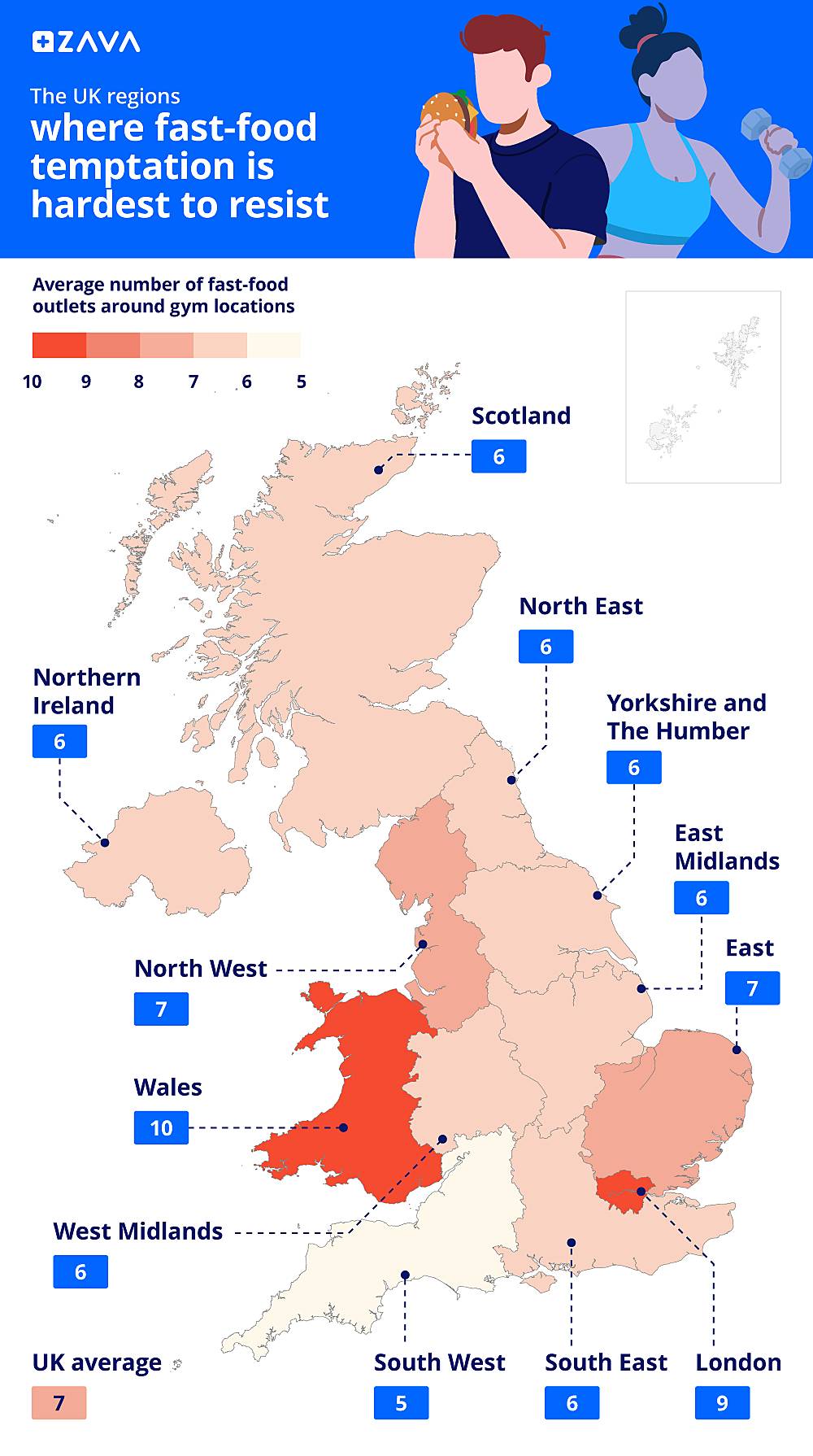
Wales tops the UK takeaway density list, with an average of 10 fast-food outlets in walking distance per gym.
London follows with nine, but some boroughs (including the City of London, Westminster, and Camden) far exceed this average.
The South West offers the healthiest environment, with only five outlets typically found nearby gyms.
Our data reveals a north-south divide. Gyms in the south are surrounded by 14.3% more fast-food options than those in the north.
By gym chain
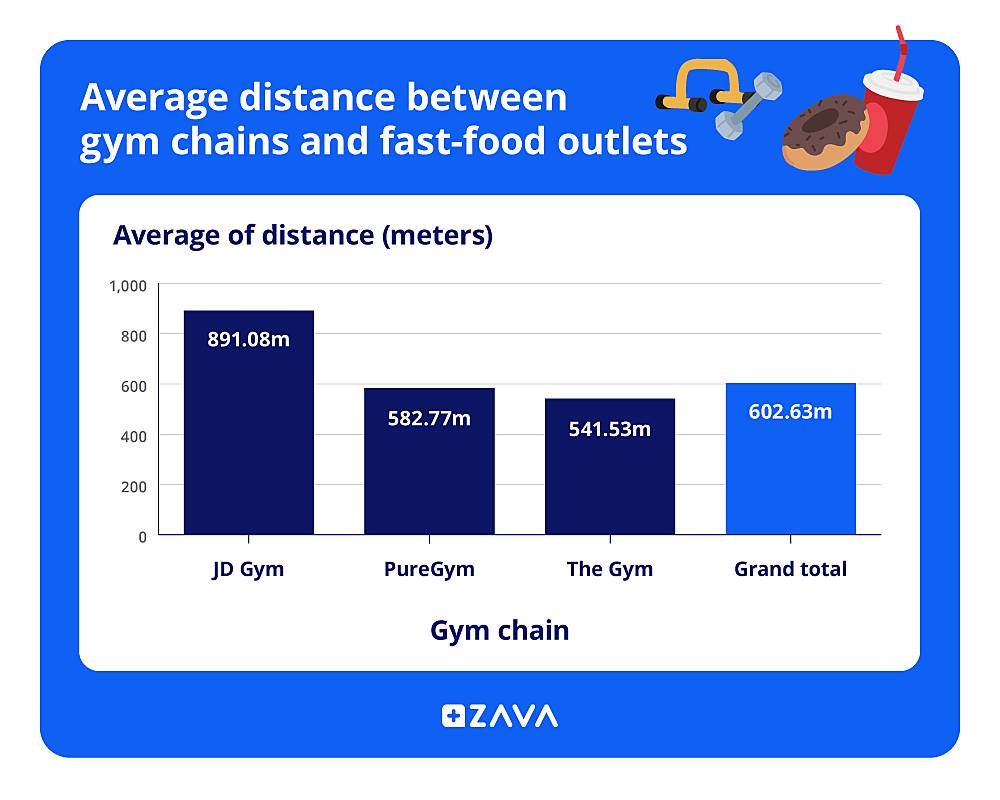
PureGym members face the most temptation, with around eight fast-food outlets within 15 minutes of each of its sites, on average, and the nearest outlet is typically positioned just 582 metres away.
The Gym Group averaged seven takeaway outlets nearby, with the closest only 541 metres away.
JD Gyms provide the most supportive environment for post-workout discipline, averaging only five outlets within walking distance and a much greater average distance of 891 metres.
By fast-food chain
Average distance between fast-food chains and gyms
| Fast food chain | Avg. distance to gym (m) | Smallest distance to gym (m) | Count near gyms | Total count (UK) | % near gyms |
|---|---|---|---|---|---|
| Wendy's | 506.24 | 53.23 | 47 | 67 | 70.15% |
| Taco Bell | 519.39 | 34.21 | 112 | 179 | 62.57% |
| TGI Fridays | 525.15 | 31.88 | 35 | 62 | 56.45% |
| Nando's | 559.47 | 11.49 | 402 | 635 | 63.31% |
| KFC | 566.63 | 14.27 | 403 | 1104 | 36.50% |
| Krispy Kreme | 569.33 | 32.58 | 135 | 176 | 76.70% |
| Chipotle | 571.36 | 7.94 | 28 | 33 | 84.85% |
| Tortilla | 581.12 | 35.71 | 120 | 143 | 83.92% |
| Burger King | 590.78 | 10.60 | 153 | 406 | 37.68% |
| Pizza Express | 591.41 | 28.67 | 224 | 436 | 51.38% |
| Five Guys | 599.18 | 39.54 | 156 | 224 | 69.64% |
| McDonald's | 599.85 | 8.91 | 589 | 1645 | 35.81% |
| Greggs | 603.07 | 12.15 | 936 | 2853 | 32.81% |
| Pizza Hut | 625.33 | 1.11 | 205 | 555 | 36.94% |
| Pepe's Piri Piri | 627.05 | 42.56 | 123 | 271 | 45.39% |
| Ben's Cookies | 637.20 | 86.38 | 20 | 26 | 76.92% |
| Domino's Pizza | 662.58 | 26.31 | 246 | 1362 | 18.06% |
| Millie's | 681.68 | 98.52 | 39 | 54 | 72.22% |
| Chicken Cottage | 692.36 | 135.69 | 40 | 81 | 49.38% |
| Shake Shack | 695.38 | 209.92 | 19 | 29 | 65.52% |
| Leon | 708.73 | 25.47 | 119 | 215 | 55.35% |
| Papa Johns | 752.75 | 26.02 | 99 | 376 | 26.33% |
| Toby Carvery | 766.54 | 71.02 | 21 | 150 | 14.00% |
| Grand total | 602.63 | 1.11 | 4271 | 11082 | 38.54% |
Wendy’s is the brand most likely to tempt gym-goers, with outlets positioned just 506 metres, on average, from the nearest gym.
Chipotle also stands out, with 84.85% of its branches located within a 15-minute walk of a gym.
Meanwhile, Toby Carvery sits at the opposite end of the scale, with only 14% of its locations situated near gyms.
London’s fast-food problem
When considered as a single region, London ranks only 17th overall for fast-food density, but borough-level data tells a different story.
- City of London gyms are surrounded by an astonishing 30 fast-food outlets, on average.
- Westminster gyms follow with 27, and Camden with 17.
These ultra-dense fast-food environments show how urban design can undermine even the best health intentions.
In some areas, the average gym-goer faces more than 20 fast-food options within a short walk, a stark reminder of how everyday surroundings shape dietary choices.
What our findings mean for public health
ZAVA’s study illustrates that environmental factors can make or break healthy routines.
Regular exercise improves heart health, mood, and long-term wellbeing, but easy access to high-calorie foods after a workout can quickly offset progress.
The research also supports the growing call for urban planning policies that take nutrition and accessibility into account. Just as cities have invested in cycle lanes and outdoor gyms to promote fitness, policymakers could consider zoning and licensing strategies to balance food environments.
At the individual level, small behavioural changes still matter:
- Planning meals or snacks before leaving for the gym.
- Scheduling workout at times when fast-food outlets are less busy.
- Choosing gyms located farther from high-density food zones.
ZAVA encourages people to pair regular physical activity with structured, medically supervised weight-loss support, helping them develop healthier habits that last.
The bigger picture: Why ZAVA is studying the UK’s health environment
Our mission extends beyond online consultations. By publishing studies like this, we aim to contribute meaningful insights into the relationship between environment, lifestyle, and health.
With the majority of UK adults classed as overweight or living with obesity, ZAVA’s clinicians see firsthand how challenging it can be to balance everyday temptations with long-term health goals.
Understanding how location, convenience, and social context influence our behaviour helps shape more effective, compassionate health interventions.
Awareness is the first step. Once people understand how their surroundings influence choices, they can plan better, and healthcare providers like ZAVA can support them with the tools and treatments that make sustained change possible.
Methodology
- ZAVA sought to identify the gyms where fast-food temptation is hardest to resist, mapping the proximity of gyms to major fast-food outlets across the country.
- To do this, the geolocations of three major UK gym chains: PureGym, JD Gym, and The Gym, were scraped from their official websites.
- Additionally, the geolocations of 25 major fast-food chains were gathered using the alltheplaces database, a set of web scrapers designed to output consistent geodata for businesses worldwide.
- The fast-food chains considered in this study include: Greggs, McDonald’s, Leon, Burger King, KFC, Shake Shack, Taco Bell, Wendy’s, Chipotle, Pizza Hut, Pizza Express, Krispy Kreme, Millie’s Cookies, Tortilla, Chicken Cottage, Nando’s, Domino’s Pizza, TGI Fridays, Five Guys, Toby Carvery, Papa John’s, Pepe’s Piri Piri, and Ben’s Cookies.
- All gym and fast-food locations were mapped using QGIS. Around each gym, a 1 km buffer was created, representing approximately 15 minutes of walking time.
- The number of fast-food outlets within this buffer was then counted to identify gyms with the highest concentration of nearby fast-food outlets.
- Distances between each gym and all fast-food outlets within the buffer were also calculated to determine average proximity.
- The data was analysed at two geographic levels: Local Authority and Regional (NUTS 1). To provide additional context, adult overweight and obesity prevalence in England (Wales and Scotland data were unavailable) for 2023/24 was sourced from the Department of Health & Social Care.
- All data collection and analysis were conducted in October 2025.
- The findings represent a snapshot of fast-food accessibility near gyms, and distances and counts should be considered indicative rather than exact, as they may vary depending on local conditions and updated business locations.
- Find the data here.